Sunday, 1 February 2015

Living in Estonia: Autumn times

For all people North of the tropics, Autumn is best symbolised by the beautiful mix of colours when trees start limiting the nutritional support to their leafs, which turn yellow and red before covering the forest grounds with a soft, colourful carpet. Nevertheless, Autumn comes in different times and feels in different regions. What we get here is far from the long, late Autumn of Western Europe and even further from the pleasant Indian Summer of Québec. Mainly because Estonia is not blessed by the Gulf Stream. 

As I pointed out in a previous post, Autumn can also be characterised by the departure of migrating birds (see The Great Migration). Or, in a less official manner, by the temperature of open air bodies of water, "if you can't swim (without wetsuit) without being frozen to death, summer is over"! In Estonia, Autumn starts somewhere in August (this year was fairly good, and it came rather towards the end of the month) and the magic colours of the trees can be enjoyed at their best early October, until the cold wind washes all leafs away. Today, First of November, there is no leaf left on trees in Tallinn. But if you head to forests and bogs inner land, you can still enjoy great colours. 

Inventing fire in Valgejärve 

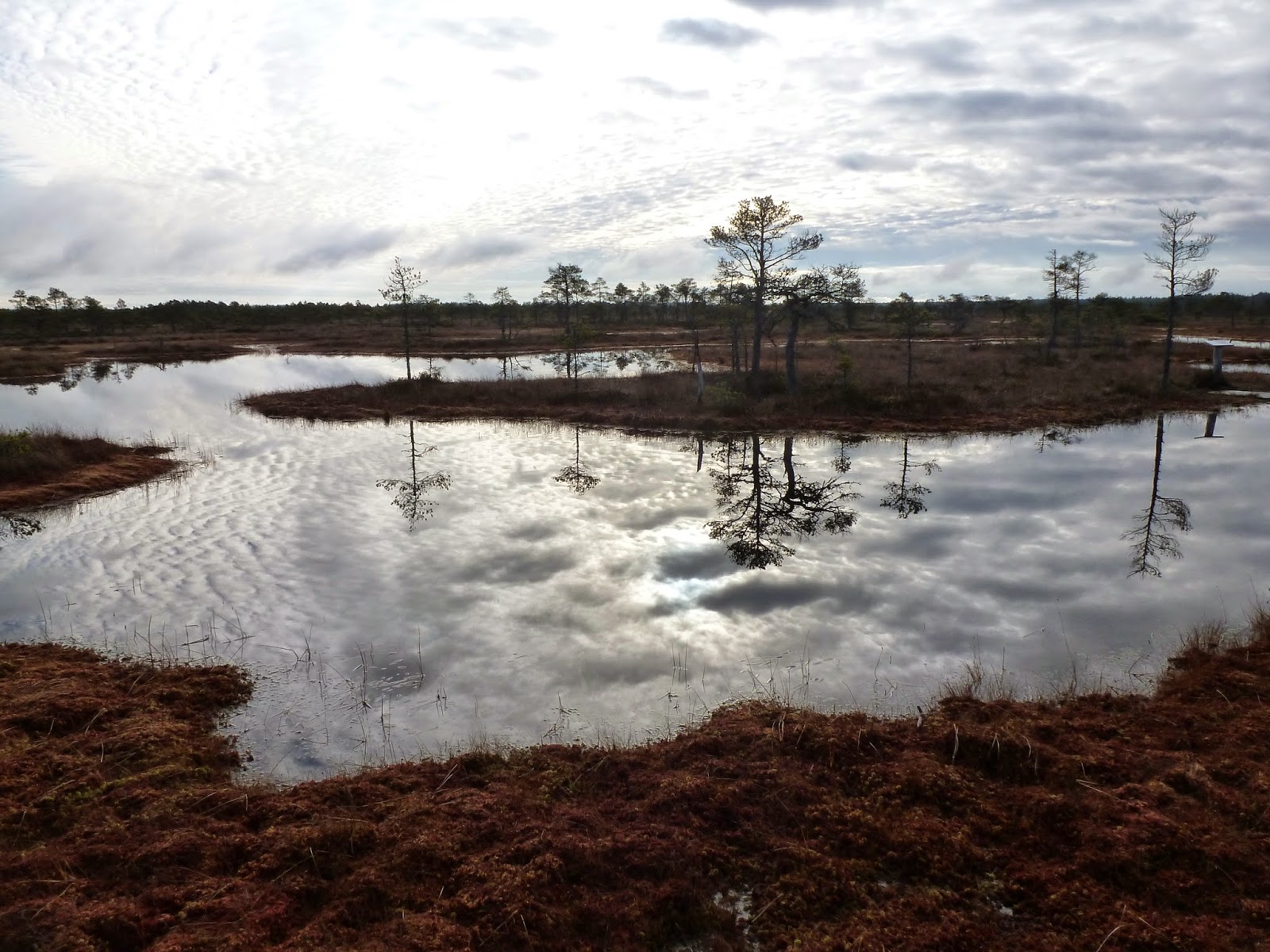
Around Valgejärve, which means the white lake, you find a large variety of landscapes, ranging from a bog that does not look like others to hilly forests. A bog is usually characterised by a very poor ecosystem (very few nutrients and species) and it is the case here too. On the other hand, this bog has a lot of grassland that is unusual. 


How to light a barbecue when nobody has brought a lighter nor matches (and there is no sun)


Mid-October, we join a few colleagues of Katri for a walk in Valgejärve. What made the episode interesting is a small misunderstanding. As in all RMK sites, there is a barbecue spot, and here there is even a big tipi of the Indian American style that fits over 10 people. We expected to share a barbecue with the group and brought sausages to grill. Something felt odd when we noticed that everyone had brought sandwiches except us, and no one had matches or a lighter to make fire... In a group of Estonians going to the woods, it is really bad luck not to have anyone with the needed stuff to make fire. On the other hand, it would be even more bad luck not to have anyone with the skills to make fire out of the environment. So we received a demonstration of a few ways to make fire... Unfortunately, there was no sunshine and no silex stone, so any attempt - even the most sophisticated - failed.


Some more species for my mushroom in the nature collection


Wet feet in Kakerdaja  

The forest of Kakerdaja offers a nice forest to walk and has a huge with a nice boardwalk of 3,5 kilometres across of it. 

First weekend of November. Close to the seaside, trees are already naked and the leafs in town have been removed during the last week (for the record, I saw the removal team operating on a pitch dark kids playground at 21:00 on Thursday night... another anachronism, from my Belgian perspective). In the inner forest grounds of Kõrvamaa, colours are still plentiful.


Despite the temperatures close to 0°C, the sunshine has invited many people to this beautiful bog.  People are all warmly dressed, with hats and gloves, nature lovers and enjoying the beautiful day. What actually differentiates them quite a bit is their footwear... and in this particular case, it matters. Part of the boardwalk, especially around the main lake, is damaged and has sunk under water. So, there is a high risk of getting wet (and water is of course not warm). It is true, most boardwalks are accessible to light shoes, even flip-flops or barefoot, as they are flat and comfortable. Here, some stretches were sinking so that you would have water up to the ankles. We had hiking boots - not high enough for the worst parts, so we had to circle in the bogs, took some risk but managed to stay dry. The lucky ones had rubber boots. The unprepared ones were with sport shoes. The silly ones where in sneakers... Board walks are popular and require regular maintenance. Moreover, it happens in some places (it was the case once in South Estonia) that beavers create dams in some places that raise the water level around. Plenty of things can make a simple walk much more exciting than expected... 


Only disappointment of the day: we had hopes to find cranberries in the bog. Nothing. Too many passers-by on the main path and it was too wet to leave it to access remote places. 

All wet in Jussi lakes

The next day was also wet, but in a different way. No sun today, only rain. We decide to explore another side of Körvamaa: the RMK trail around Jussi lakes. It is a very nice walk with a lot of variety, hills with heather, forests, lakes, and a bit of boardwalks around the lakes. A place to visit again with nicer weather...

Finally, I could find some clear evidence of beaver activities. Many trees around the long lake were bitten and beaver teeth traces were obvious. Beavers use these trees to build dams behind which they live.

Trees bitten by beavers around the Jussi lake


Living in Estonia: Dark nights and winter mood

Winter is dark. Mid November, it is already dark by 4 PM. And it gets worse everyday until the end of the year. And even when days start becoming longer again, the temperatures are still dropping and the spring is still far away. Estonians know winter can be dark and cold, and so they have recipes to cheer your life. 

Major winter events in Tallinn are the Dark Nights Film Festival, in November, the Christmas Market on the main square of the old town, and the Tartu Marathon, a 65 km long cross-country skiing race, happening mid-February. The start of this race is given at the Tehvandi stadium, where I had the honour of trying skiing for the first time.  

In between, people spend time as they can, planning the next sunny holidays or enjoying home and family. 

Kitchen pleasures

Certainly one of the main winter highlight of locals and foreigners in Estonia is the creativity they deliver in the kitchen. Around Christmas, it is very common to make gingerbreads, called Piparkook here. And any other stuff you are into during the dark weekends. 

Piparkook (gingerbreads)

Cinnamon rolls

Macarons "de Tallinn"

Do you have your reflector?

Street lighting in Tallinn is just sufficient to walk without bumping into poles. But it is not sufficient to make pedestrians visible to cars. So it is in the law that every pedestrian (and cyclists too, but that is obvious) must always have reflectors when walking outside of daylight hours. Ideally, it should hang from your jacket on your side between the thigh and the knee. There is a very active campaign about it every year when darkness starts to be around. And it is a very easy way to recognise locals from visitor. 

White Christmas in South Estonia

"Let's hope we will have snow for Christmas!" and so it was. Luckily. And somehow unexpectedly. Because until two days before, the weather was rather warm (in our referential, this means: around 2 degrees on the plus side) and rainy. 


Sunset in Pühajärve


Snow is bright ...

We wanted a snowy Christmas badly because we had planned a three-day stay in the Winter Capital of Estonia, Otepää, with the goal of spending most of the time in the open air. The perspective of  spending the short daylight time hiking in the mud was not perfect.

Picnic spot with view on the Pühajärve

"Early" morning sun on the Pühajärve beach


But we were blessed with a lot of fresh snow and that turned it into a beautiful time. Yes, snow is light. Snow means that, with a bit of artificial lighting, you can enjoy open air activities at any time, even long after sunset, which happens at... 15:30! (although you still have reasonable visibility until 16:00 when the terrain is covered with snow).


... fun ...

And snow means a lot of fun: making snowmen, walking in knee-high snow, snow tubing, skating, skiing. It was the first time I tried snow tubing, and I confirm it is a lot of fun. The first time was even scary, because I could not control the direction of my "donut", but the tracks are rather safe and the sides are slightly shaped to keep you inside. 


... but tiring

Another big première for me: cross-country skiing. As a big fan of downhill skiing, I wanted to try cross-country or Nordic skiing for a while. Could not find a better opportunity than this one! Otepää has a skiing stadium with organised tracks as well as tracks connecting villages. Because of the fresh snowfall, we decided to reach for the Tehvandi stadium where the tracks were clear and we would have the "rails" for the classic style. When we arrived, on the morning of 25 December, there were not many people, and that was a good thing, because most skiers around us were really fast! Not surprisingly, they had "Estonia" written on their blouse and Katri recognised an olympic medalist... 
The ring was far from easy, and going uphill seems to require a good deal of technique (and strength) not to slip backwards... or (let us believe so, for our ego) a more accurate waxing of the skis (but I am happy the lady at the rental did it for us anyway - it seems to be a science).

And uphill we go (or try to go) on Tehvandi stadium
Brave man digging a hole in the ice cap of the lake in search for fish


A lot of fresh snow also means that the lake ring of 13 km felt like... 25 km? Walking on deep snow was very pleasant but indeed a bit tough, especially in areas where one could clearly see that we were the first ones to walk there since the last snowfall.


Relaxing is key

Overall a healthy and quiet Christmas. While tradition in my family was to spend long hours at family gatherings, where good food and bubbly wines follow each others for a few days, here we just had the necessary food to fill the gaps left by our activities. Now, not everything was outdoors. We were staying at the Pühajärve spa hotel and had a package allowing us to use the gym and the swimming pool, with sauna, and which included a couple of extras - which we turned into a couple of back and neck massage of 20 minutes. All this was lovely and for once in my life I think I got back from my (short) Christmas holiday in much better health - both physically and mentally!

People skiing on the frozen lake... (every year they report accidents)


Snowy hike in Paunküla

And since we didn't get bored yet with all the snow, we also had a stopover in Paunküla, 45 km South of Tallinn, for another beautiful walk in deep snow.

Enjoying the peace of a frozen lake early in the morning

Never forget your warm drink

Visit of the local lodging


You don't really know what you are walking on

Thursday, 4 December 2014

The secret to a happy life? "Be generous"

This post has little to do with Estonia. Maybe the mere fact that last weekend we went to the Dark Nights Film Festival to see the British movie "Hector and the search for Happiness". Although the movie was entertaining and raised interesting questions, it is nothing remarkable. 

What is remarkable, is that - probably through an association process - Katri reminded me that precious moment last winter with my grandparents...  We were sitting together at their home, holding a small talk until nonno (grandpa) reminded us that they have been married for over 65 years! Nowadays it seems impossible. So, "What is the secret of such a long marriage?" Nonna (grandma) answers: "Patience". Nonno thinks a bit longer, nods at himself, and says "Generosity".  

If there is one thing that I hope I'll never forget about my grandfather is this simple lesson about life and happiness. It makes a lot of sense although it seems to become rare in our world. 

Sunday, 23 November 2014

Living in Estonia: first snow

Friday, 21 November 2014. First snowfall of the winter. Kids are all out making snowmen, lumememm in local language, meaning literally "snow grandmother", maybe because of the broom made of branches that people put in one of its hands.

The lumememm we found under our window when waking up (late) on Saturday

It was actually a surprise. It has been cold the last few days, but the weather forecasts the previous weekend were quite optimistic. I took a screen shot from my phone's weather app because it was remarkable... it was supposed to be sunny whole week, and under zero. I have to say, I didn't notice much sun at all! On the other hand, it is correct that the sun sets before 4 o'clock. The good thing about snow, is that it makes streets a bit more luminous. At night too, as the street lighting here is not very powerful. 

Weather forecast on Sunday 16 November


Discovering Pääsküla

Pääsküla is a district at the Southwestern edge of Tallinn, right behind Nõmme, known for its market and the never ending row of villas. The whole area is very green and also hosts a bog, the closest to Tallinn. It seems that the bog has been drained, by excavating small rivers around it. 

Armed with rubber boots, we decide to go hiking there for our first snowy weekend. It is a very nice area, with a bog walk (partly on boards) of a few kilometres and many forest trails. Once inside, one does not feel like it is so close to Tallinn. It is not silent, though, as there is on one side an open air gun shooting practice. 

The forest of Pääsküla with the first snow

Mini lumememm dancing on the watching tower


Sunday, 19 October 2014

Living in Estonia: mushrooms

October. The season of mushrooms is over. And this year was a memorable one, as Estonians told me. I cannot compare but I can tell, from my personal experience, that it was good indeed. Fun and tasty... so, even if I already talked about mushrooms earlier, I could not not write a post about mushrooms.

An afternoon at the museum

Mushrooms are everywhere, even at the museum. The Natural History Museum had the great idea to make a (of course) temporary exhibition with real-life mushrooms in September. And it was very popular. With families introducing kids to mushrooms but also with adults who simply want to increase (or confirm) their knowledge about mushrooms. The focus of most people is on whether the mushrooms they see in the forest are edible or not. Although no general rules were given, it was clearly indicated for each mushroom whether you coud eat it or not, and if you needed to boil them first. Many mushrooms need to be boiled in a lot of water to strip them of their toxicity or irritants  before actually starting to cook with them (the water used is then full of these substances and cannot be used, it is not bouillon). Mushrooms are so integrated in the Estonian culture that they also have a word which is used only for the boiling of mushrooms: kupatama. It was interesting to know that there are mushrooms which have different effects on different people: some might eat them without any trouble and even like them, while others could have severe disturbances. It was also remarkable how two types of mushrooms can look similar but one species can kill you while the other can be eaten. 

"Real-life" mushroom exhibition at the natural history museum in Tallinn

Some mushrooms are so big they can feed one person, or hide you from the burning sun

Recognising edible from poisonous mushrooms is essential, but sometimes far from easy: on the left poster, a perfectly good mushroom, on the right, a highly poisonous one (some sources online say as little as 7 g of this white Amanita can already lead to a very sad end)

This family of mushrooms is good to eat, in case of doubt you should boil them first

A French poster in the museum

Finding your own mushrooms

Mushrooming is kind of a national sport in Estonia. And many foreigners travelling to Estonia want to join the activity. Now, the problem is that mushrooming is also surrounded by secrecy. Every Estonian has its spot(s) where to pick mushrooms and they are unlikely to reveal it to others. It kind of goes like : "I could tell you where is my mushroom spot, and maybe even take you there, but I will have to kill you shortly after that!"... I did a web search on the topic and I was surprised to find out that, among most Estonian families, talking about your mushroom place is taboo. Yes, you don't even reveal your favorite places to your own family, you just keep it for yourself! wow! From that perspective, I think we have been lucky as Katri's family has always been quite open: two of her aunts have told us accurately where to find good mushroom forests, and one of them even took us there herself!

Most of the time, if you ask an Estonian about mushroom places, they will look at you oddly and give you an awkward, vague answer which will not be very helpful. Well, Katri and I now have a "secret" spot on our own. And, of course, I will not tell you where it is :)

Finding good mushroom forests is one thing. The next issue is: which mushrooms to pick? As Katri told me: "Not many things can kill you in Estonia, but mushrooms are one of these things!". A bit scary, but it is a fair warning. There are hundreds of species of mushrooms in the Estonian forests and some tend to look very similar while having very different properties. At first, it is frustrating, but it is safe to only pick the few species you know for sure you can eat. If you are in a good forest at the right moment, you may easily fill your basket or bucket with only one or two species. I can tell now that I have behind me a good half a dozen of mushrooming days and I am able to recognise 6-7 families of mushrooms. On a good day, it is sufficient to have good fun, fill my bucket and have reserves for a reasonable time afterwards.

Lunch break in the forest, at the menu: tea and orecchiette with cream and... mushrooms!

Mushroom picking in the "Switzerland of Estonia", a hilly area close to Aegviidu

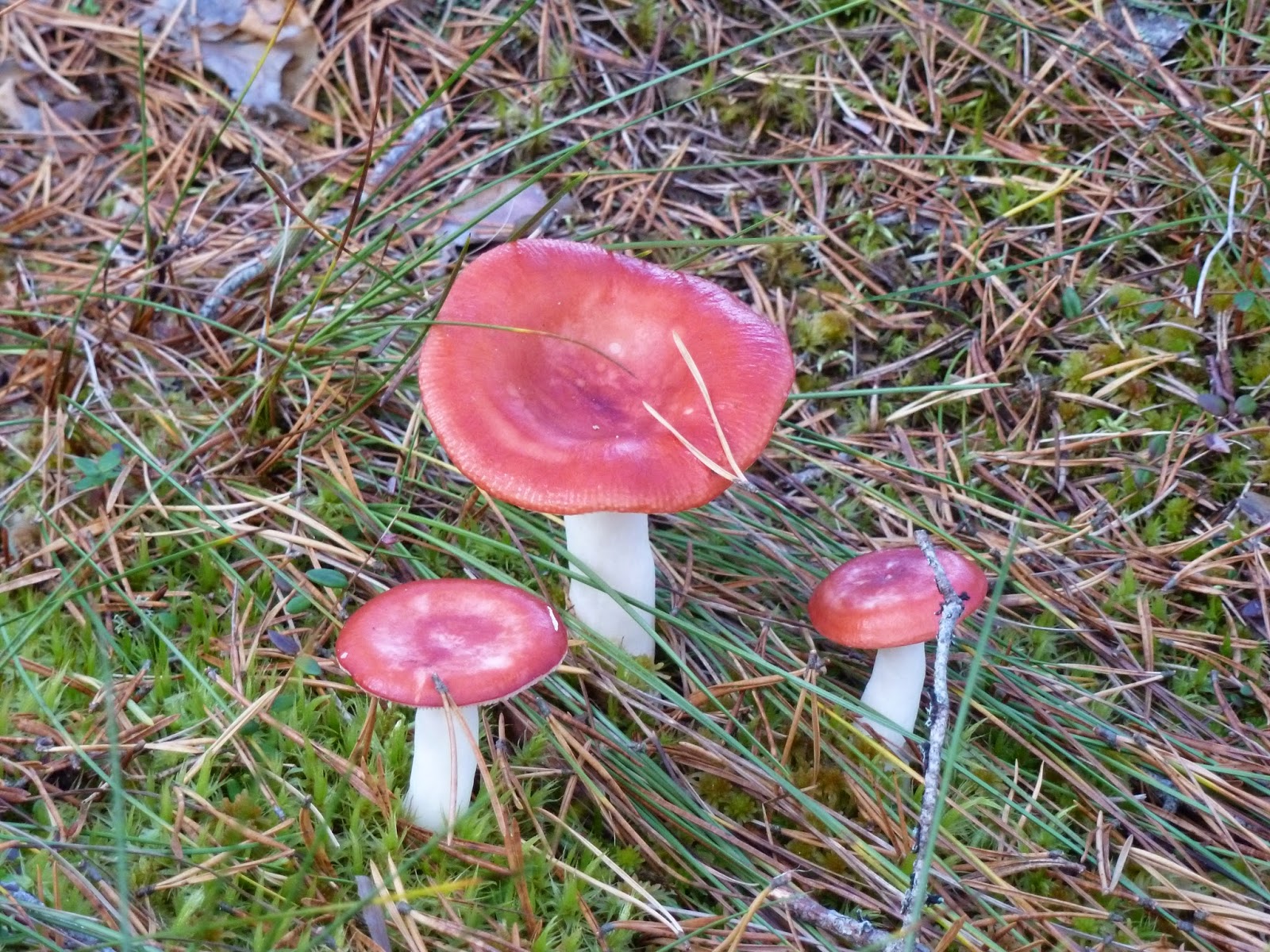
These russula are beautiful mushrooms, but need to be boiled before eating and lose their color and a lot of their texture in the process so they will be brown and grey blobs by the time they hit the table. Better than nothing though.

Me in my frenzy mushroom picking in our "secret spot"
Our pick from the "secret spot": buckets are full, so I start filling my backpack too... 


This is what a mushroom looks like when worms have gotten to it before you. This mushroom would be good to eat, if weren`t for the worms -  this you leave in the forest.

No, this one you can't eat: this is the famous Amanita Muscaria. It will not kill you but it has hallucinogenic effects.

This is also an Amanita Muscaria, a young (cute?) individual


A family of amanites. There are many amanites in the forest, also the deadly white and green ones. Do not eat.


These hallucinogenic mushrooms remind me a Disney scene, when Alice meets the smoking caterpillar.


With full bucket and backpack, we can head home now, where the next tasks awaits... processing and cooking.

Cooking with mushrooms

Picking mushrooms is fun. It is even addictive, I can tell you. The other day, when we ended up in what I call our "secret spot", I got so much into it that I could not stop picking mushrooms. There were so many nice ones and I was sad to think that in a couple of days they would grow old and all this food would be wasted...  So, even if my bucket was overfull, I continued picking the most beautiful specimens and started stacking them in my backpack!

Once you get home, however, the work starts! Yes, you need to process the mushrooms immediately otherwise they will go bad very fast. And when you get home on a Sunday night, tired of a nice weekend in the open air, you have to dedicate some hours to it. Some mushrooms just need to be brushed to get rid of the little bit of forest that came with them and then you can eat them, often by frying them in a pan. It is the case of the gyrolle (this is the French name, it is called chanterelle in English) or the kitsemampel (gypsy mushroom in English). Other mushrooms - like the cèpe (boletus in Latin and porcini in English) - require you to remove the mossy part. Then you have those that you should soak for a day or two - e.g. the männirisikas (milkcaps in English) and those that you have to boil (sometimes, twice) to get rid of any (potential) toxicity - e.g. the pilvik (russula in English).


Just a small part of our bounty


This is the gypsy mushroom, a good mushroom. It can be fried and eaten directly, no boiling at all needed, or frozen for winter. We have 5 litres in the freezer. It is also good because it grows in groups and when  you find one there are usually many more around.


Just took a photo to record some physiology. The bottom mushrooms are the red hot milk caps; they are actually super bitter when fresh, burning the tongue with their sap, but after a long soak, cooking and a marinade, they are very good to eat.  Their advantage is also than unlike the red ones on top (russula), they maintain their color and shape in the process and still look good after it all.

This reminds me of this inspired sequence from the Disney movie Fantasia, on the tune Nutcracker by Tchaïkowski.  


My mushroom risotto with porcini


The delicious mushroom quiche Katri prepared with our own picks (and on the right, the caprese with yellow tomatoes from her brother's garden). Never will you have  a another quiche with so much mushroom in it.